

How Emotional States Influence Decision-Making in Online Casinos
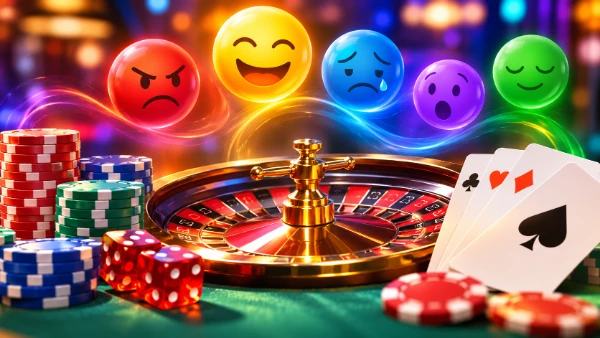
Decisions made during an online casino session are not always based on probability, financial considerations or an accurate understanding of game rules. Excitement, frustration, anxiety, boredom and even an unusually positive mood can influence how players assess risk, determine stake sizes and decide when to stop gambling. Someone who initially intends to spend only twenty minutes playing may continue for considerably longer after experiencing a series of losses or an unexpected win. The circumstances surrounding a session can therefore be just as important as the game itself. As of 2026, behavioural research into gambling provides valuable insights into the relationship between emotional responses, financial decisions and gambling-related harm, helping explain why maintaining control becomes more difficult under certain psychological conditions.
The Role of Emotions in Online Casino Decision-Making
Emotions influence how people interpret information and evaluate the potential consequences of their actions. In online casinos, decisions frequently involve uncertainty, with players committing money before knowing the outcome. When someone is emotionally agitated, immediate satisfaction may become more important than longer-term financial consequences. A decision that would normally be considered unreasonable can appear acceptable when the desire to experience excitement, recover money or relieve psychological discomfort becomes particularly strong. This change in priorities helps explain why gambling behaviour can vary substantially between sessions, even when a player participates in the same game under identical rules.
Positive emotions deserve particular attention because they are not always associated with cautious behaviour. Receiving an unexpected payout can increase confidence and create an exaggerated perception of personal ability. A player may begin attributing successful outcomes to intuition, experience or an ability to recognise patterns, despite the random nature of many casino games. Such confidence can encourage additional deposits or unnecessary increases in stakes. Previous success does not establish that subsequent outcomes will be favourable, and a pleasant emotional experience should not be confused with evidence of improved winning probabilities.
Negative emotions can influence gambling decisions through different mechanisms. Financial pressure, disappointment at work, relationship difficulties and personal uncertainty may create a desire for temporary distraction. Gambling can appear to offer relief because it occupies attention and provides immediate feedback. However, any temporary improvement in mood does not resolve the underlying problem. Financial losses may instead introduce further difficulties, creating a cycle in which emotional discomfort encourages gambling and gambling subsequently intensifies that discomfort. Recognising the original motivation for starting a session is therefore an important aspect of understanding individual behaviour.
Excitement, Stress and Impulsive Behaviour
Excitement can narrow a player’s attention towards immediate outcomes. During an emotionally intense session, monitoring expenditure or considering whether continued participation remains affordable may receive less attention. This does not mean that every excited player will lose control, but heightened emotional arousal can make previously established intentions easier to disregard. For example, someone who has already reached a personal spending limit may treat an additional deposit as an insignificant exception rather than recognising it as a departure from their original decision.
Stress can create similar difficulties, particularly when gambling is used as a response to circumstances outside the casino. A person experiencing financial problems may begin viewing gambling as a potential solution rather than an activity involving financial risk. This interpretation is especially concerning because casino games cannot provide a reliable source of income. The pressure to obtain a favourable outcome can lead to decisions that expose the individual to further financial harm. Losing money required for rent, household expenses or debt repayments may have consequences that extend well beyond the gambling session.
Impulsive decisions can also arise from tiredness, boredom or reduced concentration. Someone gambling late at night after a demanding day may pay less attention to transaction history, elapsed time and accumulated losses. Easy access through smartphones means that starting another session requires little effort, including during moments when a person would not otherwise have considered gambling. Identifying recurring emotional circumstances associated with unplanned participation can help distinguish occasional recreational behaviour from gambling that increasingly serves as a response to everyday psychological discomfort.
How Winning and Losing Affect Players’ Perception of Risk
Winning and losing influence more than an account balance. They can change expectations, confidence and the perceived importance of continuing a session. Following a win, some players begin treating recently acquired money differently from funds originally deposited. This psychological tendency, often described as the house money effect, can make further losses appear less significant. However, withdrawable winnings have genuine financial value. Once money belongs to the player, losing it carries a financial cost regardless of whether it originated from a salary, personal savings or a previous casino payout.
Losses can produce an equally important shift in decision-making. Instead of evaluating another wager independently, a player may become focused on restoring an earlier account balance. Behavioural researchers describe this response as loss-chasing. A 2023 systematic scoping review published in Neuroscience & Biobehavioral Reviews identified several forms of this behaviour, including continuing to gamble after losses, increasing stakes and returning for subsequent sessions to recover money. These patterns demonstrate why gambling-related harm cannot be assessed solely by examining the value of individual wagers.
Winning does not necessarily encourage players to finish a session either. A 2024 study published in the Journal of Behavioral Addictions examined more than 1.9 million online casino sessions involving 15,544 individuals in British Columbia, Canada. Researchers found that participants generally returned to gambling sooner following larger wins, whereas larger losses were typically associated with longer intervals before returning. The findings highlight the importance of win-chasing alongside loss-chasing. They do not establish that all individuals react identically, but they demonstrate that favourable outcomes can also encourage repeated participation.
Cognitive Biases and the Emotional Interpretation of Casino Results
The gambler’s fallacy is a common example of how expectations can become disconnected from mathematical reality. After several unsuccessful roulette bets or slot spins, a player may believe that a favourable outcome is becoming increasingly likely. For independent random events, however, previous results do not determine the next outcome. A succession of red numbers on a roulette wheel does not make black more probable on the following spin. Frustration and the desire to recover losses can nevertheless make this incorrect assumption feel persuasive, particularly when someone is already financially or emotionally invested in the session.
Another important psychological phenomenon is the near-miss effect. A slot result that visually resembles a winning combination may create the impression that a payout was almost achieved. Financially, however, a non-paying near miss remains a losing result. Its visual similarity to a winning combination does not indicate that the next spin is more likely to produce a payout. The emotional distinction between an ordinary loss and an apparent near win can nevertheless influence the desire to continue. This illustrates how the presentation of an outcome may affect a player’s interpretation without changing its actual monetary value.
Selective memory and confirmation bias can further distort perceptions of gambling performance. Memorable payouts may receive more attention than numerous smaller losses, while outcomes that support personal beliefs are remembered more readily than contradictory results. Someone might recall winning £150 during a particular session without remembering several previous deposits that exceeded that amount. Transaction records provide a more reliable account of financial performance than personal recollection. Neither emotional confidence nor the impression of being particularly fortunate changes the underlying house advantage in casino games where it applies.
Emotional Regulation and Responsible Gambling in 2026
Understanding emotional influences is particularly relevant in 2026, when online casino participation remains accessible through computers, smartphones and tablets. A gambling decision can be made almost immediately following an argument, stressful experience or unexpected financial difficulty. Recognising that emotional circumstances can affect judgement helps individuals assess whether gambling is becoming an automatic response to everyday problems. When participation is primarily motivated by a desire to escape distress, obtain urgently needed money or reverse previous losses, choosing not to gamble is more protective than attempting to manage those circumstances through additional wagers.
Responsible gambling measures increasingly address the relationship between game design and behavioural risk. In Great Britain, restrictions introduced in 2021 prohibited several online slot features associated with intensive participation, including autoplay and celebratory audiovisual effects for returns that do not exceed the original stake. Further protections introduced in 2025 established maximum online slot stakes of £2 per game cycle for adults aged 18 to 24 and £5 for adults aged 25 and above. These restrictions remain relevant in 2026, although they do not eliminate gambling-related harm or establish an individually affordable spending level.
Personal awareness remains important alongside regulatory protections. An individual who frequently regrets gambling decisions, conceals expenditure or feels unable to stop may benefit from professional support rather than relying exclusively on self-discipline. Gambling-related harm can affect employment, relationships, mental health and household finances. The seriousness of these consequences is not determined solely by how much someone loses. A relatively modest financial loss may still be significant when it affects essential expenditure, creates distress or contributes to recurring conflicts with family members.
Practical Tools for Recognising and Managing Emotional Gambling
Financial limits provide a practical way to separate spending decisions from the emotional intensity of an active gambling session. Deposit limits restrict the amount of money that can be transferred into a gambling account, while loss limits, where available, restrict financial losses over a specified period. These tools serve different purposes and should not be treated as interchangeable. In Great Britain, updated Gambling Commission requirements concerning financial limits took effect on 30 September 2026, strengthening the framework for accessible and clearly defined deposit controls. Nevertheless, setting a limit does not make gambling risk-free.
Session reminders, time limits, temporary account restrictions and self-exclusion offer additional forms of protection. Their relevance depends on the circumstances of the individual. Someone repeatedly losing track of time may find session reminders useful, whereas a person struggling to stop gambling despite financial consequences may require stronger restrictions. Self-exclusion can prevent access to participating gambling services for a specified period. Additional measures, including gambling payment blocks offered by some banks and website-blocking software, can help reduce access when account-level restrictions alone are insufficient.
Repeated loss-chasing, increasing expenditure, borrowing money to gamble and experiencing persistent anxiety about gambling are warning signs that should not be ignored. The NHS identifies several of these behaviours in its guidance on recognising gambling problems. In Great Britain, individuals can access confidential assistance through GamCare and register with GAMSTOP to restrict access to licensed online gambling operators covered by the scheme. Specialist treatment and psychological support may also be appropriate. Recognising the influence of emotions is valuable, but protecting financial stability, mental health and personal relationships must take priority over continued gambling participation.